
Bravery
BY SUSAN LAIR, PHD - CONSULTANT, EXECUTIVE COACH
Bravery is not the absence of fear. It is choosing to act despite fear because something matters more than the fear does.
I have been thinking about bravery lately.
We tend to imagine brave people doing extraordinary things in extraordinary circumstances. But I wonder if bravery in school leadership usually looks much more ordinary and often goes completely unappreciated.
Sometimes bravery is sitting across from a beloved teacher who has served the school for twenty-five years and saying, “Our children need something different now.”
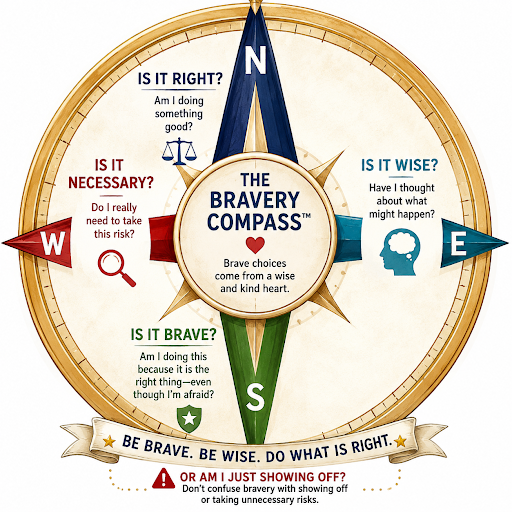
Sometimes it is telling the Board Chair, “I understand this may be what the Board wants, but I don't believe it is what is best for the school, and here is why.”
Sometimes it is standing in front of angry parents and defending a teacher who made the right decision.
Sometimes it is changing a tradition many love because the tradition no longer serves the mission.
Sometimes it is saying, “I was wrong.”
Sometimes it is saying, “I don't know.”
And sometimes bravery is resisting the tremendous pressure to do something while you are still trying to understand what is really happening.
More than sixty years ago, six-year-old Ruby Bridges walked into William Frantz Elementary School in New Orleans surrounded by federal marshals. Waiting inside was a young teacher named Barbara Henry.
Years ago, when I was a Head of School, I had the privilege of inviting Ruby and her mother to visit our school. Ruby's mother told us how other teachers had refused to teach her daughter. Parents removed their children from the school. Even families in the Bridges' own neighborhood were afraid to let their children play with Ruby, fearing retaliation.
For an entire school year, Barbara Henry taught one little girl in an otherwise empty classroom.
I asked Ruby if she had been lonely.
“Not at all,” she told me. “Ms. Henry was my best friend.”
We rightly remember the extraordinary courage of six-year-old Ruby Bridges. But I think there is another lesson in that empty classroom for those of us who lead schools.
Barbara Henry knew whom she was there to serve.
A child.
Leadership becomes complicated very quickly. There are Boards and budgets, facilities and maintenance, parents and politics, traditions and personalities, athletic competitions and meetings, enrollment and fundraising, faculty morale and institutional history. Every constituency has an opinion about what you, the Head of School, should do next, or possibly what you should do this very minute.
And somewhere amid all that noise is a child who only gets one shot at first grade.
Perhaps one of the most important questions a Head of School can ask when facing a difficult decision is remarkably simple:
What would I do if I were brave?
Not reckless.
Not impulsive.
Not determined to prove that I am right.
Brave.
Bravery listens before deciding. Bravery seeks wise counsel. Bravery considers consequences. Bravery recognizes that institutional history matters, but also understands that “we have always done it this way” is not a mission statement.
And bravery isn't only about taking care of the school.
Sometimes bravery is acknowledging that your partner and children need you, too. It is recognizing that no one else can take responsibility for your health and well-being. It is leaving the office when there is still work on your desk. It is understanding that sacrificing yourself is not the same thing as serving your school. And bravery accepts something every Head eventually learns:
Doing the right thing does not guarantee that everyone will be happy with you.
September is still early. You are listening. You are watching. You are beginning to understand the unwritten rules of your school or noticing how this year is different from the last. You are discovering which voices offer wisdom and which ideas might genuinely move the school forward. Keep doing that.
But as you listen, begin asking yourself another question:
Where might this school need me to be brave?
You don't have to answer that question today. Just don't stop asking it.
Bravery isn't always standing in front of the crowd. Sometimes it's simply staying in the room when everyone else has walked out. Because one day this year, perhaps when you least expect it, something may matter more than the fear.
RESOURCES
Hillsdale College
Hillsdale College is a small Christian liberal arts college of approximately 1,725 students, located on a 400-acre campus in Hillsdale, Michigan. Founded in 1844, the college offers an excellent resource for exploring and teaching virtues.
Go to corevirtues.hillsdale.edu. Select the menu in the upper-right corner, choose The Virtues, then select the arrow beside The Virtues and choose Cardinal Virtues.
Crossroads Academy
Crossroads Academy is a coeducational Kindergarten through Eighth Grade school in Lyme, New Hampshire. Its Core Virtues program uses literature, history, discussion, intentional reflection, and community service to help students develop strong character. Of particular interest, the program connects Courage with Wisdom, reinforcing the idea that courage is not simply bold action, but knowing when and how to act.
Go to crossroadsacademy.org. Select the Academics tab and choose Core Virtues and Character Education.
Catholic PACE Character Education Program
PACE is a Kindergarten through Ninth Grade character education program. I particularly like this resource because it does more than simply define virtues; it challenges students to think deeply about them. For example, students are asked questions such as, “Is it possible to be too courageous?”
The program also helps students understand courage in relation to other virtues and qualities, including wisdom, perseverance, resilience, justice, and concern for the common good.
There are two ways to use the program. For a more flexible approach, the PACE Manual can be used independently as a general resource. For a more structured curriculum, the manual can be paired with the individual grade-level PACE Workbooks.
Go to catholicpace.com.
The Positivity Project
The Positivity Project helps students build character and strengthen relationships by developing self-awareness, learning to understand and appreciate others, and practicing positive ways of working and living together. Its resources can be useful for exploring courage within the broader context of character strengths and healthy relationships.
Go to positivityproject.com.
Courage Resources
Courage Resources begins with an interesting premise: defining courage can be much like defining love. We often recognize courage when we see or experience it, yet describing precisely what makes an action courageous can be more difficult.
The site provides a collection of books, videos, articles, blogs, and other resources that can be used to explore courage from a variety of perspectives.
What are some of the most captivating and inspiring signature programs you’ve encountered in schools? We’d love to hear from you, email design@educationgroup.com.